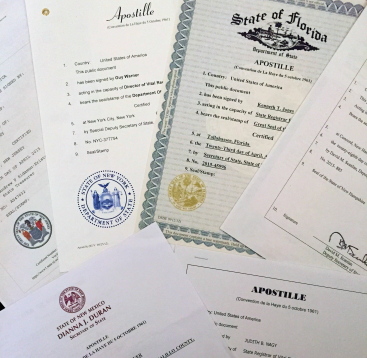
Federal Apostille: How to Apostille US Federal Documents
By Daniel Barna · Published October 28, 2026 · Updated October 28, 2026 · 6 min read
TL;DR
A federal apostille is issued by the US Department of State's Office of Authentications for documents signed by a federal official, such as FBI background checks, naturalization certificates and Consular Reports of Birth Abroad. You send Form DS-4194, the original document and a $20 fee per document. By mail it takes up to 6 weeks; walk-in drop-off in Washington, DC takes up to 7 business days. County/state issued documents go to your Secretary of State instead.
Key takeaways
- Only the US Department of State can apostille federal documents, not the state's Secretary of State.
- Common federal documents: FBI background checks, naturalization records, FS-240s, IRS Form 6166 and federal court records.
- The fee is $20 per document and is nonrefundable.
- Mail takes up to 6 weeks while walk-in drop-off takes up to 7 business days.
- Never notarize a federal document before sending it, as it will make it invalid.
- Birth, marriage, divorce and death certificates are county/state documents and go to the Secretary of State.
What is a federal apostille?
Before we dive into the how-to, tip and tricks, let's define what it is.
A federal apostille is a certificate from the US Department of State that confirms a federal document is genuine, so it can be used in another country. It checks that the signature, the official's title and the agency seal are real. It does not vouch for what the document says.
It works in the countries that belong to the Hague Apostille Convention. With the apostille attached, those countries accept the document without any further embassy stamps.
The only office that issues federal apostilles is the Office of Authentications, part of the State Department, with its office in Washington, DC.
Federal vs State Apostille: which one do you need?
Rule of thumb: It all depends on who signed it - that decides who apostilles it.
If your document was signed by... | Send it to... | Examples |
|---|---|---|
A federal official or federal agency | US Department of State, Office of Authentications | FBI background check, naturalization certificate, FS-240 |
A state, county or city official | The Secretary of State of that state | Birth, marriage and death certificates, state court records, diplomas notarized locally |
A notary public in a state | The Secretary of State of that state | Powers of attorney, affidavits, school letters |
The most common mistake are that people send a birth certificate to Washington, or an FBI check to their state. Both get sent back. If you're need to apostille a birth certificate or any state record, follow our birth certificate apostille guide instead.
Non-Hague countries: if the destination country is not in the Hague Convention, the same office issues an authentication certificate instead of an apostille. You then usually need legalization from that country's embassy too.
Which documents need a federal apostille?
According to the State Department, you need a federal apostille if your document is signed by:
A US federal official
A US consular officer
A foreign consul registered with the State Department's Office of Protocol
A military notary or judge advocate
The documents people ask about most:
Document | Issued by | Who usually needs to apostille it |
|---|---|---|
FBI background check (Identity History Summary) | FBI / Department of Justice | Visa, residency, work permit and teaching applicants abroad |
Certificate of Naturalization or Citizenship | USCIS / NARA / DOHS | Dual citizenship by descent, marriage abroad |
Consular Report of Birth Abroad (FS-240) | US Department of State | People born abroad to US parents |
Certification of US tax residency (Form 6166) | IRS | Claiming tax treaty benefits abroad |
Federal court documents | Federal courts | Legal proceedings abroad |
Patent and trademark documents | USPTO | Filing IP abroad |
Export and health certificates | USDA, FDA, HHS | Exporting food, medicine, animals and plants |
Social Security Administration letters | SSA | Pensions and benefits abroad |
Before you send it, check that your document:
Is an original or certified copy
Has an original signature, the official's printed name and title, and the agency seal
Shows the date it was issued
Is on agency letterhead
Do not notarize a federal document. The State Department says a notarized federal document is no longer valid for an apostille.
A note on the original: Always send the original document, not the copy. For a naturalization certificate, that means you'll be without it for several weeks. Plan travel and other applications around that.
How to request a federal apostille
Every request needs the same three things:
Form DS-4194 (Request for Authentications Service), with the destination country filled in (WizDox Federal Apostille can autofill the whole form for you)
The original document
$20 per document, nonrefundable. Never send cash.
Tip: If a certified document contains multiple pages attached together, such as naturalization records (Declaration of Intention, Petition for Naturalization, and Oath of Allegiance), you can consider it as one document and pay only the $20 fee instead of $60.
Then choose how to submit it. Your travel date or application decides which route makes sense.
Route | Best if you need it in... | Processing time | How to pay |
|---|---|---|---|
By mail | 4-6 weeks | Up to 5 weeks from receipt | Check or money order to "U.S. Department of State" |
Walk-in drop-off (Washington, DC) | 2–3 weeks | Up to 7 business days | Card or contactless (Apple Pay, Google Pay) |
Emergency appointment | Under 2 weeks | Same day | Card or contactless |
By mail
Send your DS-4194, document, fee and a prepaid USPS or UPS return envelope by USPS with tracking to:
Office of Authentications,
U.S. Department of State,
44132 Mercure Circle,
PO Box 1206,
Sterling, VA 20166-1206
Two details may confuse some:
Your name and address must be printed in the top-left corner of the check, and the check number must be over 100.
"delivered" on your tracking only means it reached the Sterling mail facility. It takes several more days to reach the Washington office, and the 5 weeks start from then.
Walk-in drop-off
Drop off at 600 19th Street NW, Washington, DC, between 7:30 and 9:00 a.m., Monday to Thursday. No appointment is needed, and someone else can drop off and pick up for you. Their name must be written on the receipt, and they need photo ID at pick-up.
Emergency appointments
These are only for travel within 2 weeks because an immediate family member has a life-or-death emergency. Email the office with proof of travel and proof of the emergency, such as a hospital letter or death certificate.
How long does a federal apostille take?
For most people, plan on 5 to 8 weeks in total:
Getting the document itself (an FBI check, a replacement FS-240): varies by agency
Mail to Sterling, VA: a few days
State Department processing: up to 5 weeks
Return mail: a few days, longer if you live abroad
If you're on a deadline, a courier service that walks documents in daily can bring it down to roughly 1–2 weeks. You still pay the $20 government fee on top of the courier's fee.
Tip for FBI checks: many countries only accept a background check issued within the last 3 to 6 months. Start the apostille as soon as the FBI result arrives, and check how recent your destination needs it to be.
Common mistakes that get federal apostilles rejected
Sending a state document. Birth, marriage, divorce and death certificates go to the state.
Notarizing the federal document. This makes it invalid for a federal apostille.
Sending a photocopy or scan. It must be the original or a certified copy with original signatures and seals.
Leaving the country blank on the DS-4194. The office needs it to decide between an apostille and an authentication certificate.
Paying the wrong way. By mail, it's check or money order only. Never send cash or card details.
Missing return envelope. Include a prepaid USPS or UPS envelope.
Removing staples or separating pages. Keep the document exactly as issued, and keep the apostille attached once you get it back.
Forgetting the translation. If the destination country needs one, get a professional translation and have the translated copy notarized. Never notarize the original.
Do you need a translation?
If your document is going to a country that English is not it's first language, you will need a translation as well as the apostille. The apostille proves the document is genuine; the translation lets the foreign office read it. They are separate steps.
Never notarize the original federal document. Only the translated copy can be notarized. Notarizing the original makes it invalid for a federal apostille.
There are two common ways to handle it:
Option | How it works | Watch out for |
|---|---|---|
Translate in the destination country (often the safer choice) | Get the apostille first, then have a sworn or certified translator abroad translate the document and the apostille | Usually what Spain, Italy and many other civil-law countries expect |
Translate in the US | A professional translator translates it, and the translated copy is notarized | A notarized translation is a state notarial act, so it may need its own state apostille from the notary's Secretary of State |
Before you pay anyone, ask the office receiving your documents (consulate, immigration office or registry) three questions:
Must the translation be done by a sworn or certified translator in your country?
Must the apostille itself be translated too?
Does the translation need its own apostille or notarization?
Getting this wrong is one of the most common reasons an apostilled document is still refused abroad, even when the apostille itself is perfect.
Step-by-step
- 1
Confirm it's a federal document
Check who signed it. A federal agency or official means the State Department; a state or county official means your Secretary of State.
- 2
Get the original or a certified copy
It needs an original signature, the official's name and title, the agency seal, an issue date and agency letterhead. Do not notarize it.
- 3
Get a translation if required
If the destination country needs one, have a professional translate it and notarize only the translated copy.
- 4
Fill out Form DS-4194
Enter the country where you'll use the document so you get the right certificate. WizDox apostille can do all this for you.
- 5
Pay $20 per document
By mail, use a check or money order payable to the U.S. Department of State. Multiple pages can be considered as one document and pay only the $20 fee once.
- 6
Submit your request
Mail it by tracked USPS with a prepaid return envelope, or drop it off in Washington, DC, Monday to Thursday, 7:30–9:00 a.m.
- 7
Keep it together
When the apostille arrives, don't remove it or separate any pages, otherwise it will invalidate the document and you'll have to repeat the whole process again.
Frequently asked questions
Can my state Secretary of State apostille an FBI background check?
No. An FBI check is a federal document, so only the US Department of State can apostille it. State offices will send it back.
How much does a federal apostille cost?
$20 per document, paid to the US Department of State. The fee is nonrefundable, even if your request is rejected.
How long does a federal apostille take?
Up to 5 weeks by mail, or up to 7 business days with walk-in drop-off in Washington, DC. Add mailing time both ways.
Can I request a federal apostille online?
No. The State Department only accepts requests by mail or in person. You always send the original paper document.
Does a federal apostille expire?
The apostille itself doesn't expire. But many countries only accept FBI checks and similar documents issued within the last few months.
Can someone else submit my documents for me?
Yes. A friend or courier service can drop off and pick up for you. Their name goes on the receipt, and they need photo ID at pick-up.
Can I apostille my naturalization certificate?
Yes. It's a federal document from the Department of Homeland Security, so it goes to the State Department. You must send the original.
Do I need an apostille or an authentication certificate?
It depends on the destination. Hague Convention countries get an apostille. Other countries get an authentication certificate, usually followed by embassy legalization.
Can I get a federal apostille if I live abroad?
Yes, by mail. You need a prepaid USPS or UPS return envelope, which is hard to arrange from abroad, so many expats use a US address or an apostille courier.
Does my federal document need to be translated?
Only if the destination country requires it. Many countries want a sworn translation of both the document and the apostille, done after the apostille is attached. Don't notarize it.
Sources
About the author
Daniel Barna
Daniel Barna is the founder of WizDox and has helped thousands of people order US vital records and apostilles with pre-filled official state forms.
Ready to order your record?
Upload a document and get the official state form pre-filled in minutes.
Get started with WizDox